

Wednesday, October 31, 2012
Monday, October 29, 2012
HALLOWEEN!

 A new survey targeting 5- to 13-year-olds found 94 percent of them trick-or-treat and 65 percent of them consider Halloween the best holiday of the year. Yet two thirds of the respondents agreed that they eat too much candy around that final day of October. Even most of us in the dental profession admit to enjoying a few too many sweet treats during the end of the year holidays. The good news? You can pay attention to dental care for children (and yourself!) without giving out pencils and toothbrushes on Halloween.
Tips-N-Treats
- Not all candy is created equal.
- Avoid: Taffy, caramels, gummy bears; anything that is sticky, chewy or sour
- Sticky: sticks to the teeth longer
- Sour: High acid content that can erode tooth enamel
- What's a "non-candy" treat that kids still love?
- Sugar-free gum! It stimulates saliva flow and removes debris off the teeth.
- Stickers!
- Fun bracelets!
- Glow jewelry - helpful on Halloween night, too!
- What's the best kind of candy to give out from a dentist's point of view?
- Any candy that's small - and preferably not on the "avoid" list above. Think CHOCOLATE!
- What type of treat is a dentist's worst nightmare?
- We are most concerned about the type of sugar. Sticky and long-lasting candy, like caramels or suckers, are going to linger on your teeth after finishing them and be a problem. The stickier the candy and the longer the candy remains in the mouth, the worse it is.
- What's the best kind of candy to give out?
- Chocolate! Chocolate clears out of the mouth quickly. (Not chocolate with caramel...)
- Non-chocolate option: Small packs of sugar-free gum!
- Other Must-Knows
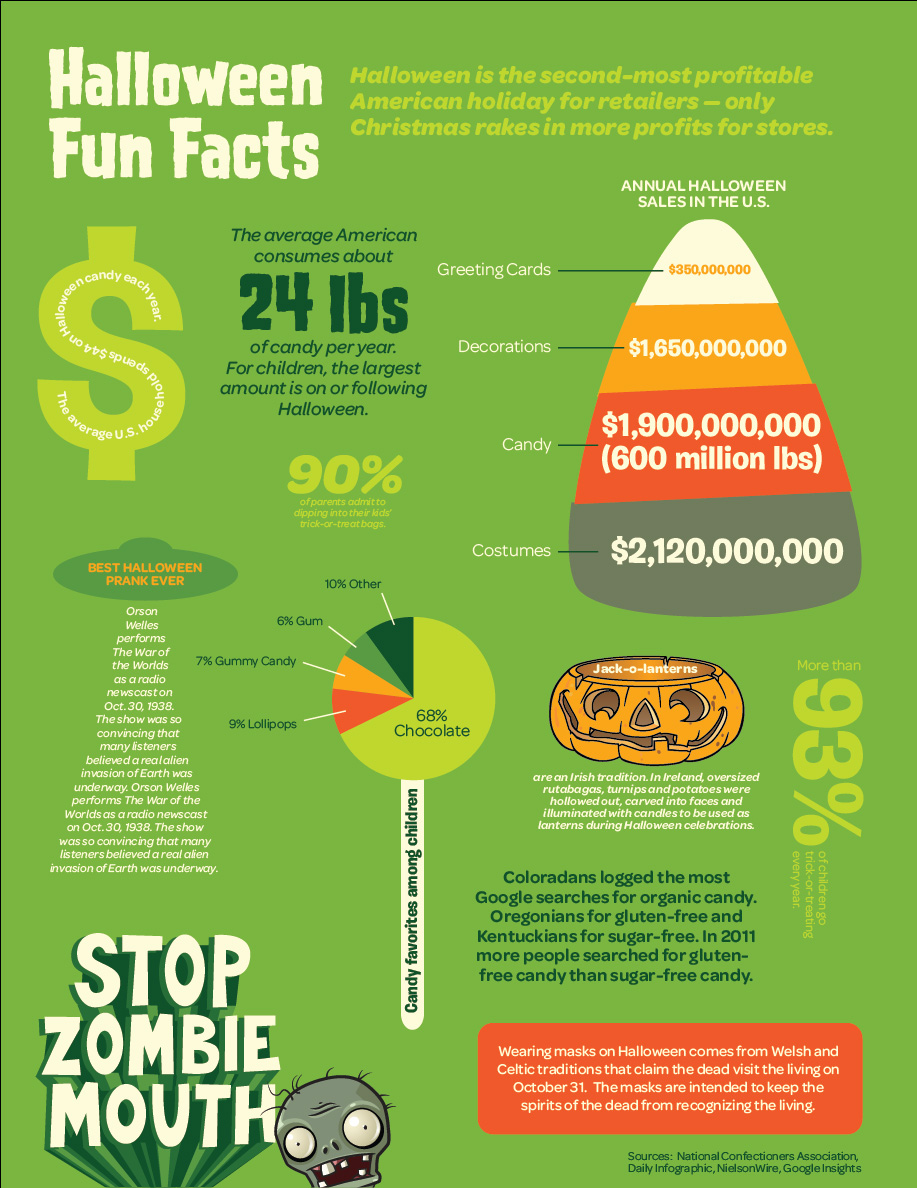
- The average child receives 90 pieces of candy on Halloween. Limit the # of pieces and times of day your children can enjoy some of their candy.
- You can bring your candy in to our Sweet Swap! Trade your candy in for gift cards or cash!

See our Dentist's Guide to Halloween 2011 from last year for more great tips!

More great resources: StopZombieMouth.com, SmilesNY.com, PopCap.com

Wednesday, October 3, 2012
National Dental Hygiene Month

National Dental Hygiene Month
This year's theme, “Keep them healthy. Keep them clean.” continues to stress easy ways that our patients can incorporate a simple oral health regimen into an active and busy life in order to maintain optimal oral health.
How can you KEEP THEM HEALTHY. KEEP THEM CLEAN?
BRUSH 2 min 2x a day
Brushing your teeth for two minutes at least twice a day remains a critical component to maintaining a healthy smile. Studies have shown that brushing for two minutes is perhaps the single most important step an individual can take to reduce plaque build-up and the risk of plaque-associated diseases, such as cavities and gingivitis.Proper brushing is essential for cleaning teeth and gums effectively.
FLOSS daily
Proper flossing or interdental cleaning removes plaque and food particles in places where a toothbrush cannot easily reach — under the gumline and between your teeth. Because plaque build-up can lead to tooth decay and gum disease, daily flossing is highly recommended.
RINSE with mouthwash
Rinsing your mouth each day with an anti-microbial mouth rinse is another important step in preventing the gum disease known as gingivitis. Speak with your dental hygienist for more information on which mouth rinse is right for you.
CHEW sugar-free gum after eating
 Chewing sugar-free gum after eating is clinically proven to be an important part of good oral health. It stimulates the most important natural defense against tooth decay - saliva - which, in turn helps fight cavities, neutralize plaque acids, remineralize enamel to strengthen teeth and wash away food particles.
Wednesday, September 19, 2012
Better to Floss Before or After Brushing?
By Lisa Collier Cool
Source; September 18, 2012
 Did you know that taking good care of your teeth and gums can not only add years to your life, but also lowers risk for heart disease, stroke, diabetes—and even memory-robbing disorders like Alzheimer’s disease? A new study of nearly 5,000 older adults found that those who brushed their teeth less than once a day were up to 65 percent more likely to develop dementia than those who brushed daily.
And here’s even more motivation to brush and floss: A new CDC study reports that nearly 65 million Americans—one out every two adults ages 30 and older—have gum disease, a far higher rate than has previously been reported. That’s dangerous, since a 2012 American Heart Association scientific statement reports that periodontal (gum) disease is a strong, independent risk factor for cardiovascular disease (heart attacks and stroke).
A Surprising Dental Controversy
What’s the Bottom Line on Flossing?
What’s the best way to keep your teeth and gums healthy? While everyone agrees that brushing at least twice a day is crucial, there’s hot debate online right now about whether it’s preferable to floss before you brush (as I do) or afterwards. Here’s a look at surprising flossing recommendations from five leading dentists:
“I’ve always advised patients to floss before they brush to break up and remove the plaque matrix between the teeth before going in with the toothbrush to sweep away the bacteria and debris they’ve dislodged with flossing.”--Mark Barry, DDS, associate dean for clinical affairs and professor, division of oral medicine, Medical University of South Carolina.
“It makes more sense, particularly for kids, to floss after brushing so you can see what you’ve missed with the toothbrush. Also, if you floss first, debris might get pushed back between the gums when you brush. It’s also important to use the right flossing technique: make a C-shape with the floss and wrap it around each tooth to clean the surface, rather than just snapping the floss up and down, which doesn’t clean the structures properly."--Mary Hayes, DDS, American Dental Association spokesperson.
“It doesn’t matter whether you floss first or brush first, because you are cleaning different surfaces of the teeth. That’s why flossing is crucial: It’s the only way to clean between the teeth, since a toothbrush can’t reach these crevices.”--Ruchi Sahala, DDS, American Dental Association spokesperson and general dentist in Freemont, CA
“The biggest thing is to remember to brush twice a day and floss once, spending several minutes removing plaque and debris between the teeth. It takes 24 to 48 hours for oral bacteria to organize into plaque, so as long as you dislodge the plaque at least once a day by flossing, you’re protecting your oral health.”--Ron Burakoff, DDM, MPH, DMD, MPH, Chair & Professor, Department of Dental Medicine, Hofstra North Shore-LIJ School of Medicine
“Either order is OK. My recommendation is to floss at night, before you go to bed. When you’re sleeping, you produce less saliva to clean your teeth and gums, so oral bacteria are free to do more damage. Therefore, it’s important to brush, flossand scrape your tongue every night to get rid of bacteria and go to bed with your mouth as clean as possible.”--Ronald M. Goodlin, DDS, President, American Academy of Cosmetic Dentistry
The American Dental Association reports brushing or flossing first are both fine, as long as you do a thorough job. However, the ADA adds that a benefit of flossing first is that fluoride from toothpaste is more likely to reach between your teeth when you brush, which may help reduce cavities.
As all of the dentists interviewed for this article agree, flossing once a day is crucial to avoid having the film of bacteria between the teeth harden into plaque and then tartar, a hard mineral deposit that can cause gums to become swollen and inflamed, leading to the earliest stage of gum disease: gingivitis.
For more tips on flossing—including a how-to video from the ADA—click here.
Subscribe to:
Posts (Atom)